Search News
Global Advanced Textile & Apparel Systems (ATAS)Industry Portal
Global Advanced Textile & Apparel Systems (ATAS)Hot Articles
Global Advanced Textile & Apparel Systems (ATAS)- Advanced Knitting Technology Applications in Seamless Sportswear and Shoe UppersAdvanced knitting technology applications are transforming seamless sportswear and shoe uppers with precision, lower waste, faster sampling, and smarter automation—discover the key benefits now.
- Textile Machinery for Apparel Buying Guide: How to Compare Capacity, Labor, and Floor SpaceTextile machinery for apparel buying guide: compare real capacity, labor needs, and floor space to choose smarter equipment, reduce risk, and improve long-term ROI.
- Automated Fabric Handling Problems: How to Reduce Wrinkles, Misalignment, and ReworkAutomated fabric handling issues can quickly cause wrinkles, misalignment, and costly rework. Learn practical fixes to improve stability, boost yield, and protect fast-changing production.
Fast fashion production gets riskier as lead times shrink
As fast fashion production races toward ever-shorter lead times, quality and safety teams face rising pressure to prevent defects, equipment failures, and compliance risks before they escalate. For operations built around automated sewing, ultra-speed weaving, digital knitting, and smart footwear assembly, the challenge is no longer speed alone. The real test is whether output can remain stable, traceable, and commercially viable when every hour of delay compresses planning, maintenance, and inspection windows. In this environment, fast fashion production has become a broader industrial risk question that connects machinery performance, labor protection, process control, and supply chain intelligence.
What fast fashion production means under compressed lead times

Fast fashion production refers to a manufacturing model designed to convert trend signals into finished apparel or footwear in the shortest possible time. In earlier supply structures, speed was mainly a logistics target. Today, it is a full-system requirement that affects yarn preparation, fabric formation, cutting, sewing, finishing, packing, and replenishment. When lead times shrink, the production line has less room to absorb machine drift, material inconsistency, unplanned downtime, or human error.
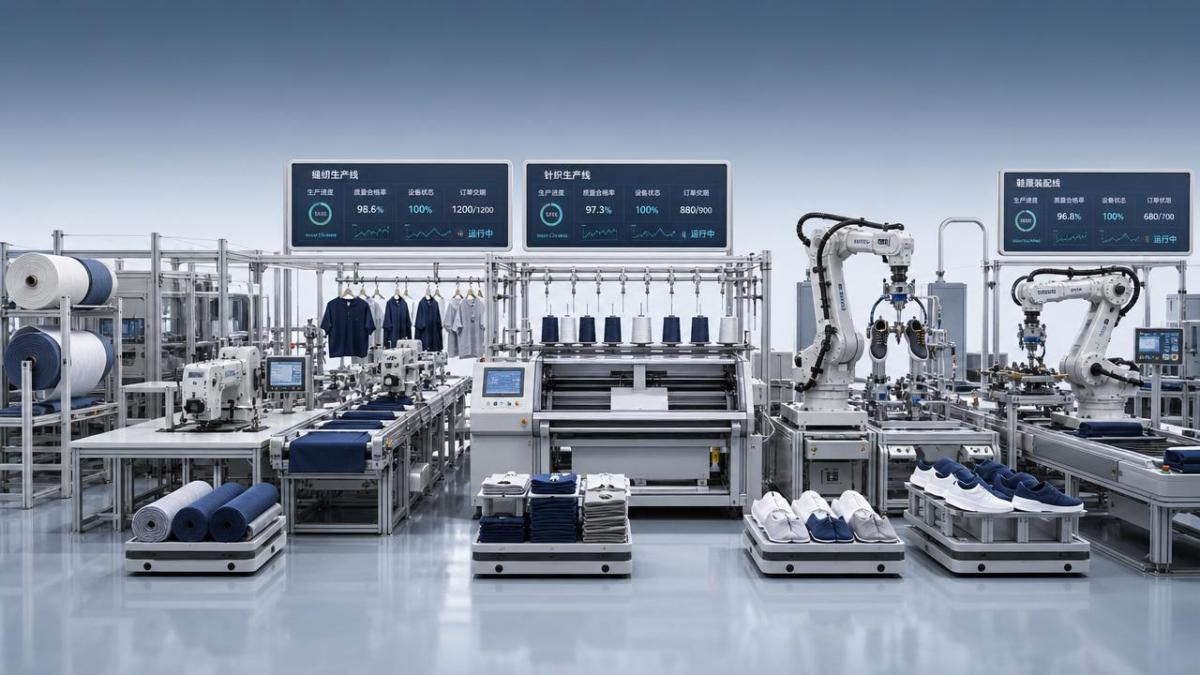
This is especially relevant in technology-driven light manufacturing. High-end spinning machines must keep yarn evenness within narrow tolerance bands. Shuttleless looms must maintain stable airflow, insertion precision, and fabric integrity at very high speed. Industrial sewing systems must coordinate operator rhythm, template accuracy, and digital monitoring without creating bottlenecks. In smart shoe-making lines, robotic spraying, upper handling, and sole attaching must align across multiple motion-control points. As a result, fast fashion production is increasingly defined by how well advanced equipment can respond to volatility without sacrificing quality or safety.
The riskier aspect comes from compression. A shorter calendar does not reduce the complexity of textile or footwear production; it simply concentrates it. That concentration raises the cost of mistakes, because defects are discovered later, corrective actions are more disruptive, and shipment delays quickly become margin losses.
Industry signals shaping the current risk profile
Several structural changes are making fast fashion production more sensitive to operational risk than in previous cycles. These changes are visible across apparel, knitwear, and footwear manufacturing systems.
- Shorter order cycles driven by real-time trend monitoring and smaller batch replenishment.
- Growing reliance on automated equipment that improves speed but requires tighter process discipline.
- Frequent material switching, including recycled fibers, stretch fabrics, and mixed uppers with uneven handling behavior.
- Regional supply chain shifts that introduce new factory ramp-up risks and variable technical maturity.
- Higher compliance expectations related to worker safety, traceability, and waste control.
The interaction between these signals matters more than any single factor. For example, a factory may install faster weaving or sewing assets, but if maintenance data, spare parts planning, and operator training do not evolve at the same pace, fast fashion production becomes unstable. The result may not appear immediately as a catastrophic failure. More often, it shows up as rising defect rates, frequent stoppages, hidden rework, inconsistent sizing, fabric distortion, adhesive variation, or missed handover times between departments.
Why fast fashion production risk now extends beyond the sewing floor
In many facilities, risk used to be associated mainly with final garment assembly. That view is now too narrow. Fast fashion production starts becoming fragile much earlier, often in fiber processing or fabric formation. Yarn irregularity can create weaving instability. Airflow imbalance in air-jet weaving can produce subtle defects that only appear after dyeing or finishing. Needle selector response issues in computerized flat knitting can alter shape consistency. In footwear, visual recognition errors around wrinkled uppers can affect robotic application quality long before a pair reaches final inspection.
This broader risk chain makes intelligence and data integration more important. ATAS closely follows how global light manufacturing is moving from labor-intensive structures to technology and capital-intensive systems. In such systems, the most valuable capability is not raw machine speed but synchronized speed: the ability of spinning, weaving, sewing, knitting, and shoe-making assets to operate as a connected response network. Fast fashion production becomes more resilient when machine data, process science, and commercial demand signals are stitched together early enough to support preventive decisions.
That is why predictive maintenance, micro-tension monitoring, robotic vision calibration, and digital thread-breakage recognition are no longer optional enhancements. They are practical safeguards against compressed-time volatility. When order windows are short, every upstream parameter becomes a downstream business variable.
Business value of controlling risk in fast fashion production
Managing fast fashion production risk delivers value in ways that go far beyond defect reduction. Stable operations protect margin, support reliable replenishment, and preserve production flexibility for future orders. In a market shaped by small-batch, quick-response manufacturing, the ability to maintain repeatable quality under time pressure becomes a strategic advantage.
- Better asset utilization: High-end equipment generates stronger returns when stoppages and rework are minimized.
- Faster decision cycles: Real-time visibility allows line adjustments before small variations become major disruptions.
- Lower waste exposure: Accurate knitting, sewing, and cutting reduce scrap, excess inventory, and correction costs.
- Improved compliance confidence: Safer and more traceable systems support environmental and labor expectations.
- Higher order credibility: Consistent output under short lead times strengthens long-term market trust.
For advanced textile and apparel systems, this value is tied to technical depth. A weaving line with strong flow-field optimization, a sewing fleet with IoT-based performance tracking, or a smart shoe-making line with robust visual correction can maintain throughput while protecting consistency. That combination is essential because fast fashion production rewards response speed only when the response is reliable.
Typical risk scenarios across textile, apparel, and footwear systems
Different production stages experience compressed lead times in different ways. The table below outlines common scenarios and the most relevant control priorities.
Practical measures for more stable fast fashion production
A practical response to rising risk begins with narrowing the gap between engineering data and production action. Fast fashion production cannot remain stable if settings are changed faster than systems can learn from previous runs. The following measures are especially useful in high-speed textile and footwear environments:
- Build parameter libraries for frequent style changes. Standardized recipes for yarn count, airflow, stitch density, adhesive application, and material handling reduce trial-and-error losses.
- Use predictive maintenance instead of calendar-only servicing. Vibration, heat, pressure, and response-time data can flag hidden equipment fatigue before output drops.
- Install inline quality checkpoints at process-critical nodes. It is more effective to detect tension variation, seam irregularity, or visual alignment drift during production than after batch completion.
- Shorten feedback loops across departments. Spinning, weaving, sewing, knitting, and assembly teams should share defect patterns quickly so root causes are found at source level.
- Prepare material-specific handling rules. Recycled blends, stretch textiles, and knitted uppers often require different tension, feed, and motion profiles than conventional materials.
- Protect workforce safety under speed pressure. Faster lines should never reduce machine guarding discipline, ergonomic review, or incident reporting rigor.
These actions work best when paired with strategic intelligence. ATAS tracks both equipment evolution and global production shifts, helping connect mechanical capability with real market timing. That perspective is important because fast fashion production risk is not only a factory-floor issue; it is also shaped by sourcing changes, regional capacity transfer, and the growing demand for flexible, zero-waste manufacturing systems.
Next-step priorities for a more resilient response
The central lesson is clear: as lead times shrink, fast fashion production becomes riskier not because speed is undesirable, but because unmanaged speed amplifies every weak point in the system. The most effective response is to treat speed, quality, safety, and intelligence as one operating framework. That means mapping where variation first appears, identifying which machines or materials create the greatest instability, and using digital monitoring to intervene earlier.
A strong next step is to review production flow from fiber to finished product and rank the top three delay or defect triggers by business impact. Then align those triggers with technical controls such as tension monitoring, flow optimization, automated defect sensing, or robotic vision recalibration. In fast fashion production, the operations that learn fastest are usually the ones that recover fastest. With the right intelligence stitching together spinning, weaving, sewing, knitting, and shoe-making systems, compressed lead times can be managed with greater confidence and far less disruption.
Recommended News