Search News
Global Advanced Textile & Apparel Systems (ATAS)Industry Portal
Global Advanced Textile & Apparel Systems (ATAS)Hot Articles
Global Advanced Textile & Apparel Systems (ATAS)- Textile Automation Technology Trends: What Mills Are Prioritizing in New Upgrade ProjectsTextile automation technology is reshaping mill upgrades with smarter spinning, weaving, sewing, and knitting systems that boost quality, flexibility, and efficiency—see what mills are prioritizing now.
- Automated Weaving Systems: Core Technical Parameters That Affect Speed and Fabric QualityAutomated weaving systems perform best when speed, tension control, air stability, and diagnostics work together. Learn which parameters truly improve fabric quality, efficiency, and long-run mill output.
- How to Evaluate a Smart Garment Factory for Capacity, Quality Control, and ScalabilitySmart garment factory evaluation made practical: learn how to assess real capacity, built-in quality control, and scalable systems before choosing a supplier.
Flexible manufacturing sounds efficient, but where is the limit?
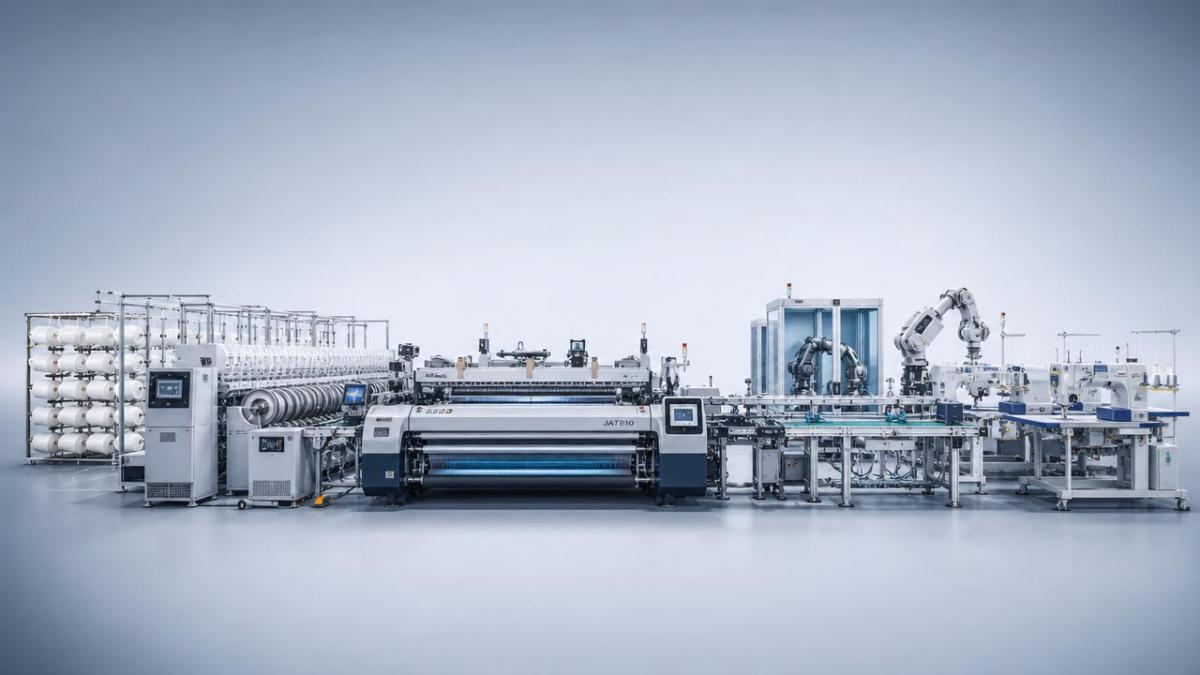
Flexible manufacturing is often presented as a universal answer to unstable demand, shorter product cycles, and rising labor pressure. In reality, its value depends on where agility creates measurable output and where complexity begins to erode margins. In advanced textile, apparel, and footwear systems, the real question is not whether flexible manufacturing improves efficiency, but where its technical and economic limit appears. From high-end spinning and shuttleless weaving to automated sewing, computerized flat knitting, and smart shoe-making lines, each production scenario has a different threshold for changeover speed, process stability, and return on automation.
For intelligence platforms such as ATAS, this boundary matters because modern light manufacturing no longer competes on volume alone. It competes on how precisely machines handle flexible materials, how fast production lines switch between SKUs, and how well digital systems translate demand signals into executable shop-floor actions. That is where flexible manufacturing stops being a slogan and becomes a scenario-based engineering decision.
When does flexible manufacturing create value, and when does it create friction?

The limit of flexible manufacturing is rarely defined by one machine. It is usually defined by the interaction between four constraints: product variety, material variability, automation coordination, and cost of response. A factory producing stable, high-volume basic fabric can gain more from extreme speed and uptime than from frequent line reconfiguration. By contrast, a line serving fast fashion, seasonal knitwear, or mixed footwear orders needs fast pattern switching, digital traceability, and low setup loss.
This is why scenario judgment matters. Flexible manufacturing works best where demand volatility is high enough to justify responsiveness, but not so chaotic that every order becomes a custom engineering project. Once setup complexity, operator intervention, data inconsistency, or quality drift rises too far, the system can become technically flexible but commercially inefficient.
Scenario 1: High-end spinning lines where flexibility is limited by fiber behavior
In spinning, flexible manufacturing is often expected to support multiple fiber blends, yarn counts, and order sizes on the same platform. The practical limit appears when raw material variability changes the stability window of the process. Cotton quality, staple length distribution, moisture variation, and synthetic fiber blending ratios all influence tension control, twist consistency, and breakage rates.
A spinning system may technically switch between products, but each switch affects carding setup, drafting parameters, rotor or ring performance, and downstream winding quality. If the frequency of changes is too high, the gain from flexibility can be outweighed by cleaning time, calibration loss, and quality verification effort. In this scenario, the key judgment point is whether product diversity shares a compatible processing window. If not, flexible manufacturing should be segmented into modular production families rather than forced into one universal line.
Core judgment points in spinning
- How often fiber mix and yarn count change within a week
- Whether auto-doffing, tension control, and monitoring systems can absorb variation
- How much waste and rework rise after each recipe change
- Whether quality data can close the loop in real time
Scenario 2: Shuttleless weaving where speed and flexibility compete directly
In ultra-speed air-jet or other shuttleless loom environments, flexible manufacturing has a more visible trade-off. The same infrastructure that enables top insertion speed also demands tight control over air pressure, yarn quality, warp tension, and loom timing. Frequent style changes reduce the advantage of high-speed weaving because every adjustment introduces instability risk.
For woven fabric production, the limit of flexible manufacturing often appears when the cost of downtime exceeds the value of a faster response cycle. Fabrics with different densities, yarn types, finishes, or width requirements may need distinct machine settings and maintenance conditions. A highly flexible weaving plant therefore needs more than digital scheduling; it needs simulation-backed parameter libraries, preventive maintenance logic, and strong upstream yarn consistency.
The practical lesson is clear: if the product mix involves similar constructions, flexible manufacturing can support short runs with acceptable losses. If the mix spans highly different technical fabrics, fashion fabrics, and compressed delivery windows, line grouping and selective standardization usually outperform unrestricted flexibility.
Scenario 3: Automated sewing where the true bottleneck is not the machine, but the process map
Apparel sewing is one of the clearest use cases for flexible manufacturing, especially under small-batch, quick-response models. Yet automated sewing reaches its limit when material drape, part deformation, and style complexity exceed what templates, sensors, and motion paths can reliably control. Soft, stretchy, slippery, or layered fabrics remain difficult because the material itself moves unpredictably.
A digital sewing fleet with IoT monitoring, template sewing, and thread-break recognition can significantly shorten changeovers. However, flexibility drops when each new garment style requires excessive engineering time for clamping, path programming, operator retraining, or exception handling. In other words, flexible manufacturing in sewing depends on process standardization upstream: pattern rules, seam design, tolerance control, and bundle logic must be machine-friendly from the beginning.
What determines the limit in sewing?
- Fabric behavior under feed and clamping
- How repeatable seam geometry is across styles
- The ratio between engineering setup time and actual production time
- Whether data from machines can inform balancing and quality correction
Scenario 4: Flat knitting and smart footwear where flexibility becomes a design-to-production problem
Computerized flat knitting and smart shoe-making lines are often considered advanced expressions of flexible manufacturing because they can combine personalization with scalable output. In 3D seamless knitting or flying-knit uppers, flexibility is driven by digital patterns, yarn path control, and reduced cutting waste. In smart shoe assembly, 3D scanning, robotic spraying, and automated sole attaching make mixed production more realistic.
But the limit arrives when design freedom exceeds process discipline. If upper structures, sizes, materials, adhesives, and finishing routes vary too much, robotic consistency becomes harder to maintain. Vision systems may struggle with irregular wrinkles, reflectivity, or deformable shapes. Here, flexible manufacturing is not only a machine issue; it is a digital product architecture issue. Standardized data models, constrained customization, and validated process windows are what keep flexibility profitable.
How scenario needs differ across textile, apparel, and footwear production
Practical ways to adapt flexible manufacturing to the right scenario
- Measure flexibility by total response cost, not only changeover speed. Include downtime, scrap, validation labor, and data handling effort.
- Build modular production cells. Flexible manufacturing works better when similar products share a stable process envelope.
- Standardize digital recipes. Parameter libraries, machine settings, and quality rules reduce risk during switching.
- Use intelligence systems to predict instability. ATAS-style technical intelligence can support better decisions on flow fields, drive response, and robotic vision limits.
- Align product design with automation. The most effective flexible manufacturing strategy often begins in product development, not on the shop floor.
Common misjudgments that push flexible manufacturing beyond its useful limit
One common mistake is assuming that more SKU coverage always means better flexibility. In practice, excessive coverage can lower line efficiency, increase quality variation, and slow maintenance cycles. Another misjudgment is treating automation as a complete substitute for process discipline. Without stable material input, structured recipes, and feedback data, even advanced equipment cannot sustain profitable flexibility.
A third blind spot is ignoring supply chain speed. Flexible manufacturing only delivers full value when procurement, planning, and logistics can respond with equal precision. A highly adaptable sewing line or shoe-making cell still loses advantage if yarn, fabric, trims, adhesives, or molds arrive late or with inconsistent quality.
The next step: define the real boundary before investing in more flexibility
The smartest path is to map each production scenario against its own technical limit. Review where product variation is truly profitable, where machine precision starts to fall, and where digital coordination can remove friction. For spinning, weaving, sewing, knitting, and smart footwear lines, the right question is not “How flexible can the system become?” but “Which kind of flexible manufacturing creates durable operational advantage?”
ATAS supports this judgment by connecting machine intelligence, process science, and market signals into one framework. When production leaders understand the actual limit of flexible manufacturing, they can invest with greater clarity, improve asset utilization, and build faster-response operations without losing control of quality, waste, or capital efficiency.
Recommended News